 Translate
Sri Ranganatha Swamy Temple
About Sri Ranganatha Swamy Temple
Introduction to Sri Ranganathaswamy Temple, Srirangam
On an island cradled between the Kaveri and Kollidam rivers in Tiruchirappalli, Tamil Nadu, the Sri Ranganathaswamy Temple stands as one of the most extraordinary religious complexes anywhere on Earth. Spanning roughly 156 acres, it is widely regarded as the largest functioning Hindu temple in the world, and scholars frequently rank it alongside global landmarks such as Angkor Wat, the Vatican, and the Potala Palace in terms of sheer scale. Dedicated to Lord Ranganatha, a reclining form of Vishnu, the temple holds the distinction of being the first and foremost among the 108 Divya Desams — the sacred shrines of Vishnu celebrated in the ancient Tamil devotional hymns of the Alvars.
For pilgrims, this is Bhoologa Vaikundam, Heaven on Earth — Vishnu's primary abode in the mortal world. For heritage travelers and architecture enthusiasts, it is a living museum of over a thousand years of South Indian temple-building, bearing the imprint of Chola, Pandya, Hoysala, and Vijayanagara patronage across seven concentric enclosure walls and twenty-one towering gopurams, including the Rajagopuram, the tallest temple tower in Asia. Whether your interest is devotional, architectural, or historical, Srirangam rewards a visit that moves slowly enough to take in a complex genuinely vast enough to be mistaken for an entire town.
This guide covers the temple's history and legends, how to reach it from Trichy and beyond, the best time to visit, its key attractions and rituals, food, hotels, a realistic itinerary, nearby places, practical travel tips, and answers to the questions travelers ask most often before visiting.
Why Srirangam Resonates with Tamil and Vaishnavite Diaspora
For Tamil families settled abroad, particularly those from a Sri Vaishnava background, Srirangam often carries a significance well beyond that of a typical heritage stop. Many families trace their own devotional lineage back to teachings that originated here through Ramanuja and his predecessors, and a visit to Srirangam can feel less like sightseeing and more like returning to the theological wellspring of an entire tradition carried forward through generations, wherever in the world those generations have since settled.
History of Sri Ranganathaswamy Temple
Few temples anywhere in India can claim a history as layered and continuously documented as Srirangam's, spanning legendary origins in Hindu cosmology through more than a millennium of verifiable royal patronage, invasion, and restoration. Understanding these overlapping layers — myth, dynasty, and centuries of political upheaval — helps explain why this single temple complex carries such extraordinary weight within South Indian religious history.
The Legend of the Ranganatha Idol
According to temple tradition, the idol of Ranganatha was first worshipped by Lord Brahma in Satyaloka, the celestial realm, before being gifted to King Ikshvaku, the legendary ancestor of Lord Rama, and passed down through the Ikshvaku dynasty for generations. Rama himself is said to have worshipped the idol, and after his victory in the Ramayana war, he gifted it to Vibhishana, the righteous brother of Ravana who had aided Rama's cause and been installed as king of Lanka. As Vibhishana carried the idol homeward, he paused to rest on the banks of the Kaveri at Srirangam — and, according to legend, the idol became immovable, choosing to remain permanently at this spot. This is why the deity at Srirangam faces south, toward Lanka, a distinctive orientation that sets it apart from the eastward-facing sanctums found at most Hindu temples. Devotees still point to this legend today as the reason the site is regarded as uniquely self-chosen rather than founded by any human hand.
Sangam-Era Origins and Early Chola Patronage
Srirangam's significance as a sacred site predates its grandest architecture by many centuries. The temple is referenced in Tamil literature from the Sangam era, roughly the 6th century BCE to the 4th century CE, and appears in the celebrated Tamil epic Silappatikaram. According to the Puranas, the temple in something closer to its historical form was first constructed by the Chola king Dharmavarma, with later tradition holding that the idol was subsequently rediscovered by chance within dense forest growth by a Chola king out on an expedition, prompting him to establish it as one of the great temple complexes of the region. During the early Chola period, from roughly the 9th to 10th centuries, kings including Aditya Chola and the celebrated Raja Raja Chola I expanded and enriched the temple, cementing Srirangam's status as a central hub of Tamil Vaishnavism and setting the foundation for the vast complex that later dynasties would go on to expand even further.
Ramanuja and the Flowering of Vaishnava Philosophy
Srirangam holds a uniquely important place in the history of Vaishnava philosophy, having been the base from which the 11th-century philosopher-saint Ramanuja, along with his predecessors Nathamuni and Yamunacharya, shaped the Sri Vaishnava tradition that continues to influence Hindu theology across South India today. Ramanuja's Vishishtadvaita school of qualified non-dualism, developed and refined during his years at Srirangam, remains one of the most influential philosophical frameworks within Hindu thought, and his own physical presence remains a part of the temple to this day: his preserved form, revered by devotees as Thaan Kattina Perumal, is enshrined within the complex, making Srirangam one of the very few temples in India where a historical philosopher-saint's own remains are venerated alongside the presiding deity.
Hoysala Patronage and the Age of Invasions
The Hoysala dynasty, ruling from the 10th through 14th centuries, contributed further sculptures and architectural additions during the 12th century, continuing the temple's expansion under royal support. This period of steady growth was violently interrupted in the early 14th century, when forces under Malik Kafur, a general of the Delhi Sultanate, invaded the region in 1311, followed by further raids in 1323. To protect the sacred idol from desecration, temple priests smuggled it away and hid it in the hills of Tirupati, where it remained safeguarded for over sixty years before eventually being restored to Srirangam. This extended period of exile is remembered today as one of the most dramatic chapters in the temple's history, an episode devotees still recount as testament to the extraordinary lengths taken to protect Ranganatha across the centuries.
Vijayanagara Restoration and Later Conflicts
Srirangam's fortunes were revived under the Vijayanagara Empire during the 16th century, whose rulers undertook substantial restoration and further architectural embellishment of the temple complex. The site later became a flashpoint once again in the late 16th century, caught between Mughal expansion and the regional Nayak rulers, before eventually coming under British administration with the establishment of the Madras Presidency, remaining so until India's independence in 1947. Throughout these centuries of shifting political control, the temple's seven concentric prakaram walls, with a combined length of more than six miles, were progressively built up, in part specifically to help defend the inner sanctums from future invasion, a defensive logic still visible in the layered structure of the complex today.
A UNESCO Tentative World Heritage Site
In recognition of its outstanding architectural and historical significance, Sri Ranganathaswamy Temple has been placed on UNESCO's Tentative List for World Heritage Sites, a designation reflecting its unique status as a temple-town — a religious complex so vast and continuously inhabited that it effectively functions as a self-contained urban settlement, a typology UNESCO considers exceptional within South Asian heritage. Formal inscription remains pending, but the tentative listing alone has drawn renewed international scholarly attention to the site's conservation needs and its significance as a living, still-evolving example of South Indian temple urbanism rather than a static archaeological ruin.
How to Reach Sri Ranganathaswamy Temple
Srirangam's location just outside Tiruchirappalli city makes it one of the more conveniently accessible major pilgrimage sites in South India, with strong air, rail, and road connectivity that compares favorably even against some of Tamil Nadu's larger, more remote temple towns.
By Air
- Tiruchirappalli International Airport (TRZ) is the nearest airport, roughly 8-12 km from the temple, with direct flights from Chennai, Bengaluru, Mumbai, and Hyderabad, as well as international routes to Dubai and Singapore relevant to NRI and diaspora travelers.
- Pre-paid taxis and app-based cabs connect the airport to Srirangam in well under half an hour under normal traffic conditions.
By Train
- Srirangam Railway Station sits just about 1 km from the temple, making it the single most convenient rail option for pilgrims.
- Tiruchirappalli Junction (Trichy Junction), roughly 9 km away, offers broader connectivity, including routes from Chennai (around 5 hours), Bengaluru (around 6 hours), Mumbai, Hyderabad, and Coimbatore.
By Road
- Srirangam is approximately 325 km from Chennai (5-6 hours), 155 km from Coimbatore (about 2.5 hours), and 85 km from Madurai (about 1.5 hours), making it a practical stop on a broader Tamil Nadu temple circuit.
- From Trichy Junction, auto-rickshaws to the temple entrance typically cost a modest fare, and city buses run every 15 minutes or so along the route.
- Regular KSRTC and private buses connect Srirangam with Chennai, Madurai, and other major Tamil Nadu cities.
For NRI and US-Based Travelers
Travelers coming from the US can fly directly into Chennai and connect onward to Tiruchirappalli, or in some cases access Trichy directly via Gulf hub connections given the airport's international routes to Dubai and Singapore. Given Srirangam's compact scale relative to other South Indian pilgrimage circuits, it works well as either a focused dedicated trip or as one stop within a broader Tamil Nadu temple tour taking in Thanjavur and Madurai.
Best Time to Visit Sri Ranganathaswamy Temple
Ideal Months: November to February
The cooler months from November through February offer the most comfortable conditions for exploring Srirangam's vast open courtyards and multiple prakarams, where extended walking in Tamil Nadu's summer heat can otherwise be genuinely taxing. This window also coincides with the temple's most significant festival season, making it the natural choice for most first-time visitors planning around both comfort and cultural richness.
Vaikunta Ekadasi (December–January)
The temple's principal annual festival, Vaikunta Ekadasi, spans roughly 21 to 22 days across December and January, drawing enormous crowds from across India. The undisputed highlight is the opening of the Paramapada Vasal, also known as the Swarga Vasal or Gateway to Heaven, on the festival's most sacred day; Vaishnava tradition holds that passing through this gate during the festival carries profound spiritual significance, comparable to attaining liberation. Devotees planning to attend should arrive two to three days ahead, since accommodation in Srirangam and Trichy fills up completely weeks in advance, and queues for the main day can begin forming before midnight.
Other Major Festivals
Beyond Vaikunta Ekadasi, the temple hosts the Chithirai Car Festival in April, Panguni Uthiram in March-April (marking the divine wedding of Lord Ranganatha and Goddess Ranganayaki), an annual chariot festival in January or February, along with Vasantotsavam, Jyeshtaabhishekam, Pavitrotsavam, and Teppotsavam (the float festival), each observed with its own distinct rituals and considerable local participation. Together, these festivals mean that virtually any visit timed within the cooler winter months has a reasonable chance of coinciding with at least some form of special ritual activity at the temple.
Daily Timings
The temple is generally open from around 6:00 AM to 9:00 PM daily, with darshan available throughout the day except during scheduled pooja and naivedyam breaks. The early-morning Viswaroopa Seva, held between roughly 6:00 and 7:15 AM, offers a particularly atmospheric start to a visit for those able to arrive at opening time, with noticeably thinner crowds and cooler temperatures than later in the day.
Top Attractions
Srirangam's scale means a single visit can involve walking several kilometers within the complex alone, and understanding its layout of concentric enclosures helps make sense of the sheer breadth of what there is to see, from monumental gateway towers down to the smallest carved details in its pillared halls.
The Seven Prakarams
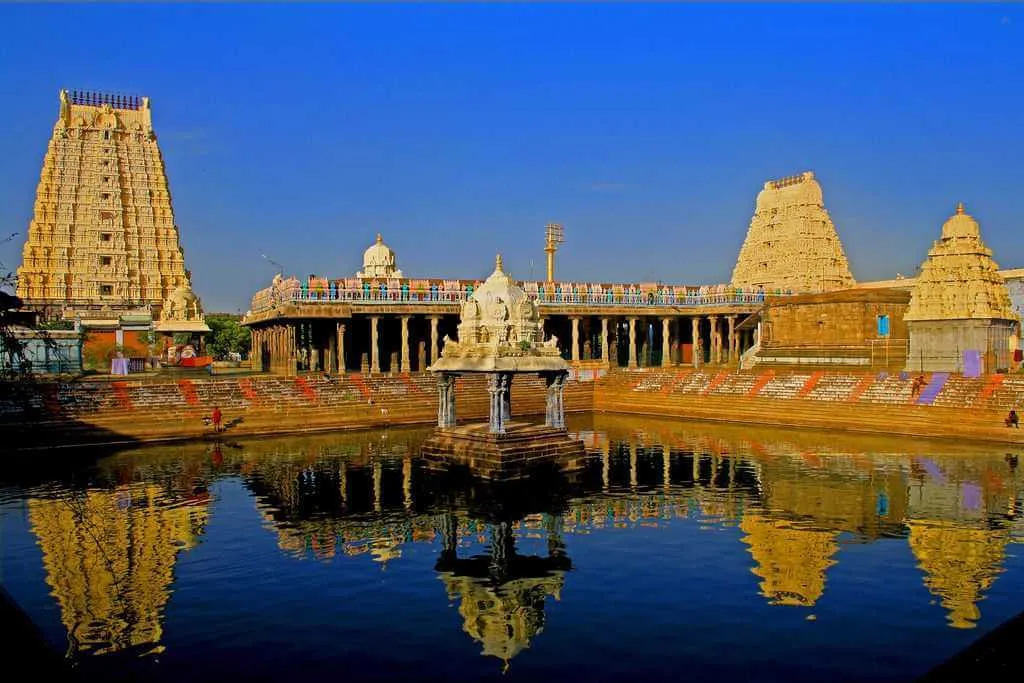
The temple is structured around seven concentric enclosure walls, or prakarams, with a combined length exceeding six miles — an almost unparalleled scale of fortified sacred architecture. The outer prakarams contain markets, homes, and the everyday life of Srirangam town itself, while the innermost enclosures house the temple's most sacred shrines, meaning visitors pass through what is effectively a living town before reaching the sanctum sanctorum. This layered structure, part fortress and part functioning neighborhood, is one of the clearest physical illustrations anywhere in India of the temple-town concept that UNESCO has cited in considering Srirangam for World Heritage status.
The Rajagopuram
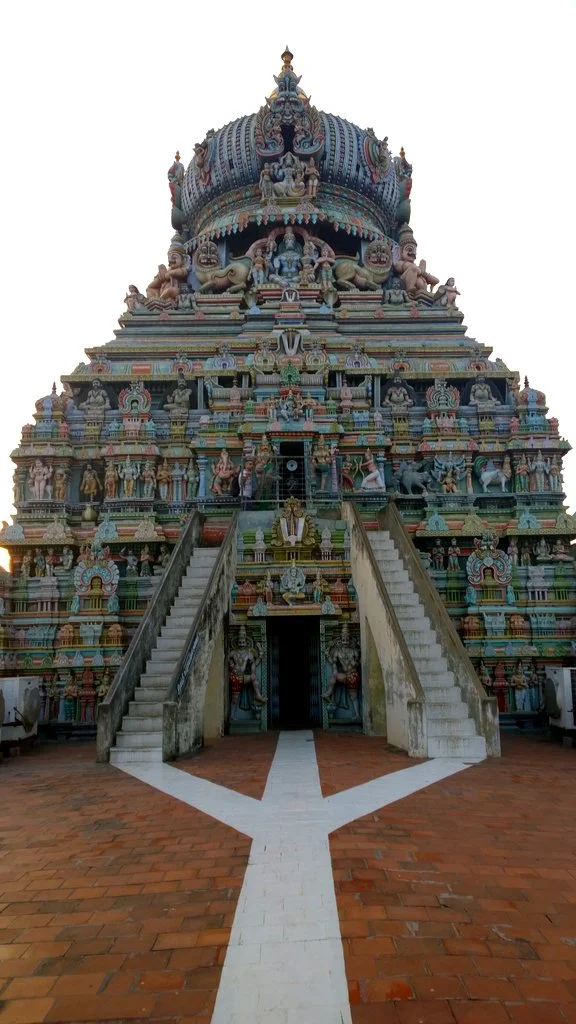
Rising above the southern entrance, the Rajagopuram is the tallest of the temple's 21 gopurams and is recognized as the tallest temple tower in all of Asia, a modern-era completion of a tower whose construction had remained unfinished for centuries before being completed in the 20th century. Its scale makes it visible from a considerable distance across the flat Srirangam landscape, and for many visitors, the first glimpse of this tower rising above the surrounding town is what truly signals arrival at one of India's most significant religious sites.
The Sanctum of Lord Ranganatha
At the heart of the complex, the gilded vimana (dome) shelters the reclining form of Lord Ranganatha, oriented uniquely southward in accordance with the temple's founding legend. The sanctum remains the emotional and spiritual center of the entire 156-acre complex, and reaching it typically involves navigating several inner prakarams filled with subsidiary shrines and ornately carved pillared halls, a journey many devotees describe as itself part of the devotional experience rather than a mere logistical prelude to darshan.
Ayiram Kaal Mandapam (The Thousand-Pillared Hall)
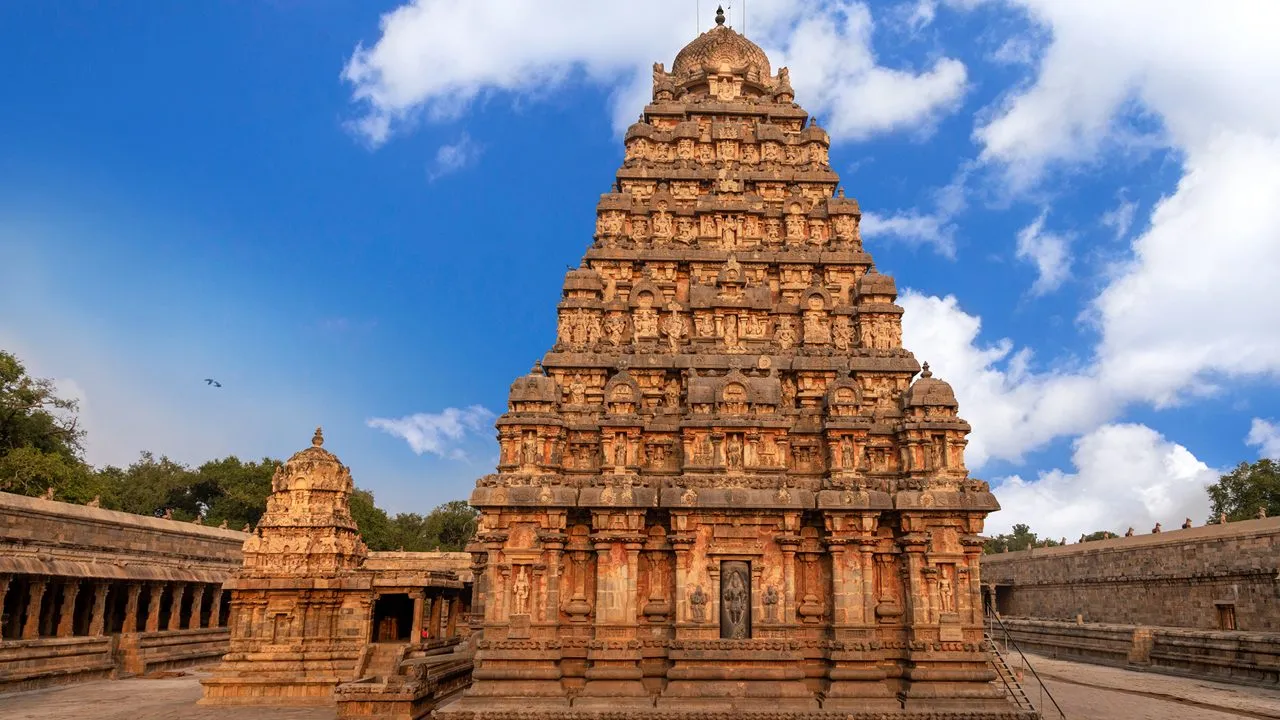
This vast pillared hall, its name translating to hall of a thousand feet or pillars, showcases the extraordinary scale of Vijayanagara-era stone carving, with each pillar individually sculpted and the hall as a whole standing as one of the finest surviving examples of this architectural style anywhere in South India. Visitors interested in temple architecture often find this hall alone worth an extended stop, given the sheer density and variety of carved detail across its many columns.
The Shrine of Ramanuja
Within the temple complex, a dedicated shrine houses the preserved form of the 11th-century philosopher-saint Ramanuja, revered by devotees as Thaan Kattina Perumal. This shrine offers a rare, tangible connection to one of Hindu philosophy's most influential historical figures, still venerated in the same complex where he once taught, and it remains an essential stop for any devotee following the broader Sri Vaishnava tradition he helped establish.
The Nine Sacred Pools
Scattered throughout the temple grounds, nine sacred water pools (theerthams) serve various ritual purposes and add a further layer of tranquil, reflective space within the otherwise densely built complex, offering visitors quieter corners away from the temple's busiest thoroughfares, and several of these pools carry their own individual legends tied to specific episodes of the temple's mythology.
Rituals and Spiritual Significance
Beyond its architecture, Srirangam remains an intensely active center of daily Vaishnava worship, with a ritual calendar shaped by centuries of Sri Vaishnava theological tradition.
The Foremost of the 108 Divya Desams
Srirangam holds the distinction of being the first and foremost among the 108 Divya Desams, the sacred Vishnu shrines celebrated in the Naalayira Divya Prabandham, the collection of devotional hymns composed by the Tamil Alvar saints between roughly the 6th and 9th centuries CE. This foundational status means a pilgrimage here is considered by many Sri Vaishnava devotees to be the essential starting point for a fuller Divya Desam pilgrimage circuit, a distinction that has shaped the temple's reputation across South India for well over a thousand years.
Special Sevas
Beyond general darshan, the temple offers a range of special sevas that devotees can sponsor, including Thirumanjanam (ritual bathing of the deity with milk, sandal paste, and holy water), Sahasranama Archana (chanting of Vishnu's thousand names), and Pradosha Pooja, performed on particularly auspicious evenings. These can typically be booked at the temple counter, with some available for advance booking through official temple channels, and devotees traveling from abroad may find it worthwhile to arrange these in advance if timing a visit around a specific family occasion.
One of the Eight Self-Manifested Shrines
Srirangam is counted among the eight Swayambhu Kshetrams — sites where Vishnu's form is believed to have manifested on its own rather than being consecrated by human hands — placing it in an especially select category of Vaishnava sacred geography alongside temples such as Tirupati and Badrinath, a distinction that further reinforces the temple's standing as one of the most theologically significant Vishnu shrines anywhere in India, quite apart from its architectural scale.
Hidden Gems Around the Temple
The Outer Prakaram Markets
Many visitors move quickly through the outer enclosures to reach the inner sanctum, but the markets and streets within the temple's outer prakarams — particularly the flower market, especially vibrant during festivals like Vaikunta Ekadasi and Pongal — offer a genuine slice of everyday Srirangam life that's easy to overlook when focused solely on the central shrine, and a slow walk through these outer streets reveals just how much the temple functions as the literal economic and social center of the surrounding town.
Quiet Corners Near the Sacred Pools
Away from the temple's busiest pathways, the areas surrounding the nine sacred theerthams tend to offer a noticeably calmer, more contemplative atmosphere, particularly outside of festival season and peak morning hours, making them a good option for visitors who want a break from the crowds without leaving the temple grounds entirely.
Lesser-Visited Subsidiary Shrines
Among the temple's 50 sub-shrines, several receive far less footfall than the main sanctum, offering visitors interested in a deeper, slower exploration of the complex's full religious and artistic scope a chance to see carvings and shrine architecture many day-trippers miss entirely, and often the best way to discover these is simply by wandering the inner prakarams without a fixed route in mind.
Things to Do in and Around Srirangam
While the temple itself can easily fill the better part of a day, Trichy and the surrounding area offer plenty to round out a longer visit, blending devotional, architectural, and culinary experiences.
- Walk the full circuit from the outer prakarams to the inner sanctum, budgeting 2-3 hours for a complete, unhurried visit.
- Attend the early-morning Viswaroopa Seva for a particularly atmospheric start to the day.
- Visit the Ramanuja shrine to pay respects to one of Vaishnavism's most influential historical philosophers.
- Explore the Ayiram Kaal Mandapam's thousand-pillared hall for its extraordinary stone carving.
- Time a visit around Vaikunta Ekadasi for a rare and spiritually significant festival experience, crowds permitting.
- Visit the nearby Rock Fort Temple in Trichy for panoramic city views.
- Explore Jambukeswarar Temple at Thiruvanaikaval, one of the Pancha Bhoota Sthalams dedicated to the water element.
Local Food to Try
Srirangam and Trichy sit at the heart of Tamil Nadu's rich vegetarian temple-town culinary tradition, offering some of the state's most classic South Indian dishes alongside distinctly local specialties.
Temple-Town Vegetarian Fare
- Traditional South Indian meals — served on banana leaves, widely available at pure-vegetarian restaurants throughout Srirangam and Trichy.
- Temple prasadam — including sweet and savory offerings distributed to devotees, an integral part of the temple's daily ritual life.
- Trichy-style filter coffee — Tamil Nadu's coffee culture is on full display in Trichy's traditional coffee houses, a worthwhile stop between sightseeing.
- Idli, dosa, and vada — classic South Indian breakfast staples available at both simple local eateries and more established restaurants.
Tips for Travelers
Given Srirangam's status as a major pilgrimage center, the immediate temple area leans heavily vegetarian; travelers seeking a broader range of cuisines, including non-vegetarian options, will find considerably more variety in central Trichy, a short drive away.
Where to Stay: Hotels Near Srirangam
Given Srirangam's role as a major pilgrimage destination alongside its proximity to a full-sized city, travelers have a genuine choice between staying immediately adjacent to the temple or basing themselves in central Trichy.
Srirangam Town
Simple lodges and pilgrim-oriented guesthouses cluster close to the temple itself, offering maximum convenience for early-morning darshan at the cost of more limited amenities compared to central Trichy hotels.
Trichy City Hotels
Most travelers seeking a wider range of comfort and dining options base themselves in Tiruchirappalli city, roughly 8-12 km away, where budget, mid-range, and business hotels are all well represented.
Booking Considerations
Outside festival periods, accommodation in Trichy and Srirangam is generally easy to arrange with modest advance notice. During Vaikunta Ekadasi, however, both Srirangam and Trichy hotels fill up completely weeks ahead, and travelers hoping to attend should book as early as possible, ideally a month or more before the festival dates.
Budget Guide
A Srirangam visit remains one of the more affordable major pilgrimage experiences in South India, since core access to the temple carries no cost at all.
Entry and Offerings
General entry and darshan at Sri Ranganathaswamy Temple are free. Specific special darshans and sevas, including Thirumanjanam and Sahasranama Archana, carry their own separate fees, payable at the temple counter.
Approximate Daily Budgets (India-Based Travel)
- Budget traveler: Local buses or auto-rickshaws, simple lodging near the temple, and inexpensive vegetarian meals — a very affordable way to experience Srirangam.
- Mid-range traveler: A private taxi around Trichy and Srirangam, a comfortable city hotel, and a mix of local and restaurant dining.
- Comfort/luxury traveler: A private car with driver for a broader Tamil Nadu temple circuit, an upscale Trichy hotel, and sponsored special sevas at the temple.
For International Travelers
Once in India, day-to-day costs around a Srirangam visit — transport, meals, and any sponsored sevas — remain inexpensive by US standards, with international airfare making up the larger share of an overall trip budget.
Sample 2-Day Itinerary
Day 1: Sri Ranganathaswamy Temple
- Early Morning: Attend the Viswaroopa Seva and begin a full circuit of the temple from the outer prakarams inward.
- Late Morning: Explore the Ayiram Kaal Mandapam and the Ramanuja shrine.
- Midday: Lunch at a traditional South Indian vegetarian restaurant in Srirangam.
- Afternoon: Continue exploring the inner prakarams and sacred pools at a relaxed pace.
- Evening: Return for evening darshan and take in the illuminated gopurams after dark.
Day 2: Trichy's Wider Heritage
- Morning: Visit the Rock Fort Temple in central Trichy for panoramic views over the city and river.
- Midday: Lunch in Trichy, sampling a broader range of Tamil Nadu cuisine.
- Afternoon: Visit Jambukeswarar Temple at Thiruvanaikaval, one of the five Pancha Bhoota Sthalams.
- Evening: Depart for onward travel or continue toward Thanjavur or Madurai as part of a broader Tamil Nadu temple circuit.
Nearby Places to Visit
Tiruchirappalli district and the broader Kaveri delta region are home to some of Tamil Nadu's most significant Dravidian temple architecture, making it easy to build a full multi-day itinerary around the area.
- Rock Fort Temple (Ucchi Pillayar Koil): A dramatic hilltop Ganesha shrine in central Trichy, offering sweeping views over the city and the Kaveri.
- Jambukeswarar Temple, Thiruvanaikaval: One of Tamil Nadu's five Pancha Bhoota Sthalams, representing the water element, a short distance from Srirangam.
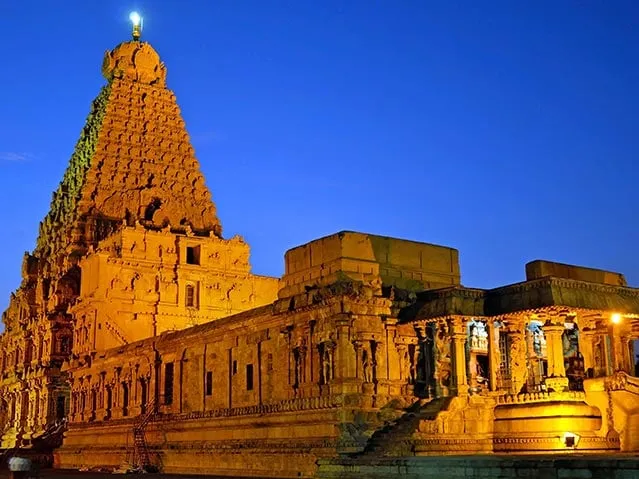
- Thanjavur Brihadeeswarar Temple: A UNESCO World Heritage Chola-era temple, roughly 55 km away, considered one of the greatest achievements of Dravidian architecture.
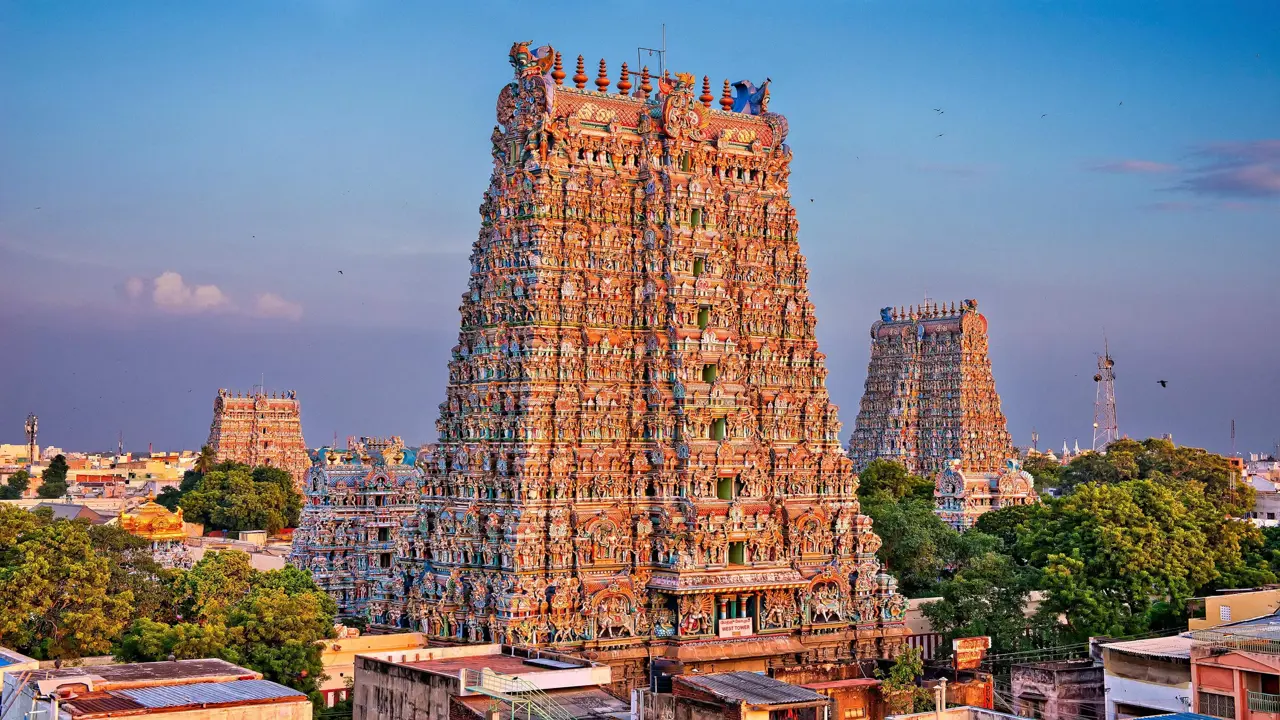
- Madurai Meenakshi Amman Temple: One of India's most famous temples, roughly 130 km away, well suited to a broader multi-temple Tamil Nadu itinerary.
- Nachiyar Koil: Another significant Divya Desam near Kumbakonam, appealing to travelers interested in a fuller Vaishnava pilgrimage circuit.
Building a Tamil Nadu Temple Circuit
Srirangam's central location within Tamil Nadu makes it a natural anchor for a broader temple-focused itinerary, easily combined with Thanjavur's Chola architecture and Madurai's Meenakshi Temple to create a comprehensive tour of South India's greatest Dravidian religious monuments within a single, well-paced multi-day trip.
Travel Tips
Given the temple's scale and its status as one of the most significant Vaishnava pilgrimage sites in India, a little preparation goes a long way toward a smooth, unhurried visit.
- Dress code: Men are generally expected to wear a dhoti or long trousers with a shirt, and may be asked to remove their shirt before entering certain inner sanctum areas; women should wear a saree, salwar kameez, or other traditional attire covering shoulders and legs.
- Budget real time: Given the temple's scale, allow at least 2-3 hours for a proper visit; rushing through risks missing much of what makes Srirangam so remarkable.
- Footwear: Footwear must be removed before entering the temple premises, with storage available near the entrances.
- Photography: Check current photography rules with temple staff, particularly around the inner sanctum and during active rituals.
- Festival planning: If attending Vaikunta Ekadasi, arrive several days ahead, book accommodation well in advance, and be prepared for very large crowds, including queues that can begin forming before midnight on the main festival day.
- Cash for offerings: Carry small denominations of Indian currency for sponsored sevas and offerings, since card acceptance at temple counters can be limited.
- Combine with Trichy sightseeing: Given its proximity, most visitors pair a Srirangam trip with the Rock Fort Temple and other central Trichy attractions in the same visit.
- Language: Tamil is the primary local language, though Hindi and English are generally understood by hotel staff, drivers, and shopkeepers in Trichy's tourist-facing businesses.
Frequently Asked Questions
The following questions cover the practical and historical details travelers most often want clarified before planning a Srirangam visit.
1. What is Sri Ranganathaswamy Temple famous for?
It is famous as the largest functioning Hindu temple in the world, spanning 156 acres, and as the first and foremost of the 108 Divya Desams dedicated to Lord Vishnu, featuring 21 gopurams, seven concentric enclosure walls, and a history stretching back well over a thousand years, along with its connection to the influential philosopher-saint Ramanuja.
2. How far is the temple from Trichy city and the airport?
The temple is roughly 8-12 km from Tiruchirappalli International Airport and central Trichy, typically a short 20-30 minute drive by taxi or auto-rickshaw, making it one of the more easily accessible major pilgrimage sites in South India.
3. What are the temple's darshan timings?
The temple is generally open from around 6:00 AM to 9:00 PM daily, with darshan available throughout the day except during scheduled pooja and naivedyam breaks; timings can shift during major festivals, so it's worth confirming current hours before an early-morning visit.
4. Is there an entry fee?
No, general entry and darshan are free. Specific special darshans and sevas, such as Thirumanjanam or Sahasranama Archana, carry their own separate fees payable at the temple counter, with proceeds generally going toward the temple's ongoing maintenance and ritual activities.
5. When is Vaikunta Ekadasi, and is it worth planning a trip around?
Vaikunta Ekadasi typically falls in December or January and spans roughly 21 to 22 days, with the opening of the Paramapada Vasal (Gateway to Heaven) as its spiritual centerpiece. It is an extraordinary experience for those who don't mind very large crowds, but requires booking accommodation and travel well in advance, ideally a month or more ahead of the festival dates.
6. Why does the deity at Srirangam face south instead of east?
According to temple legend, the idol was being carried to Lanka by Vibhishana after the Ramayana war when it became immovable at Srirangam, coming to rest facing south toward Lanka — a distinctive orientation that sets it apart from the eastward-facing sanctums typical of most Hindu temples across India.
7. What should I wear when visiting?
Men are generally expected to wear a dhoti or long trousers with a shirt, sometimes removing the shirt before entering certain inner sanctum areas; women should wear a saree, salwar kameez, or other traditional attire covering shoulders and legs, in keeping with standard South Indian temple etiquette.
8. How much time should I plan for a visit?
Given the temple's vast scale, a proper visit covering the main sanctum, Ayiram Kaal Mandapam, and Ramanuja shrine typically takes 2-3 hours at minimum; allow considerably more time during festivals or for a more thorough exploration of the complex's 50 subsidiary shrines and nine sacred pools.
9. Is Sri Ranganathaswamy Temple a UNESCO World Heritage Site?
It is currently on UNESCO's Tentative List for World Heritage Sites, recognized for its exceptional temple-town typology, though it has not yet received full UNESCO World Heritage Site inscription, a process that can take many years even for well-documented candidate sites.
10. Can Srirangam be combined with a visit to Thanjavur or Madurai?
Yes — Thanjavur's Brihadeeswarar Temple is roughly 55 km away and Madurai's Meenakshi Temple roughly 130 km away, both easily combined with a Srirangam visit into a broader Tamil Nadu temple circuit spanning some of the region's finest Dravidian architecture.
11. What is the significance of Ramanuja's shrine within the temple?
Ramanuja, the 11th-century Vaishnava philosopher-saint, built much of his theological career at Srirangam, and his preserved form, revered as Thaan Kattina Perumal, remains enshrined within the complex — a rare instance of a historical philosopher-saint venerated alongside the presiding deity in the same temple, and a site of particular importance for followers of the Sri Vaishnava tradition he helped establish.
Conclusion
Sri Ranganathaswamy Temple offers an experience of scale and continuity almost unmatched anywhere in the Hindu world — a 156-acre temple-town shaped by more than a millennium of Chola, Pandya, Hoysala, and Vijayanagara patronage, invasion, and restoration, and still functioning today as a living center of daily Vaishnava worship. Whether you're drawn by its legendary origins in the Ramayana, its role as the foremost of the 108 Divya Desams, its connection to the philosopher-saint Ramanuja, or simply the extraordinary architectural achievement of its seven prakarams and 21 gopurams, Srirangam rewards travelers willing to move slowly through a complex genuinely vast enough to be mistaken for a town in its own right. Pair a visit with Trichy's Rock Fort Temple and, time permitting, Thanjavur or Madurai, for a comprehensive tour of Tamil Nadu's greatest Dravidian temple architecture.
Few religious sites anywhere manage to compress so much history, theology, and architectural ambition into a single continuous walking circuit. From the moment visitors pass beneath the towering Rajagopuram to the quiet, incense-scented final approach to the reclining form of Ranganatha, Srirangam offers a genuinely rare sense of moving through layered centuries rather than simply visiting a single moment frozen in time — a fitting reputation for a temple its own devotees have long called Heaven on Earth.
Photo Gallery
What you'll experience
- 1
Pilgrimage
- 2
Architectural exploration
- 3
Cultural immersion
- 4
Spiritual practices
- 5
Festivals
Visit Information
Opening Hours
Entry Fee
Best Time to Visit
November to February
Location
Srirangam, Tamil Nadu
Contact
For inquiries: NA
Share this destination:
