 Translate
Thanjavur Maratha Palace
About Thanjavur Maratha Palace
Introduction: The Royal Seat of Nayaks and Marathas
Situated in the heart of Thanjavur (Tanjore), approximately 55 kilometers (a 1-hour drive) east of Tiruchirappalli (Trichy), Tamil Nadu, the Thanjavur Maratha Palace (locally known as Aranmanai) is a magnificent royal fortress complex. Originally constructed in the 1530s by the Nayak rulers of Thanjavur and later expanded by the Maratha dynasty during the 17th and 18th centuries, this expansive complex serves as a living testament to the artistic, cultural, and administrative heritage of post-Chola South India.
Unlike traditional military forts, the palace complex was designed as an intellectual and artistic enclave. Today, it houses world-renowned art galleries, century-old manuscripts, royal weapons, and architectural towers that showcase a unique synthesis of Dravidian, Indo-Saracenic, and European design styles.
Key Attractions & Architectural Highlights
The Thanjavur Palace complex comprises several interconnected royal halls, museums, and observation towers:
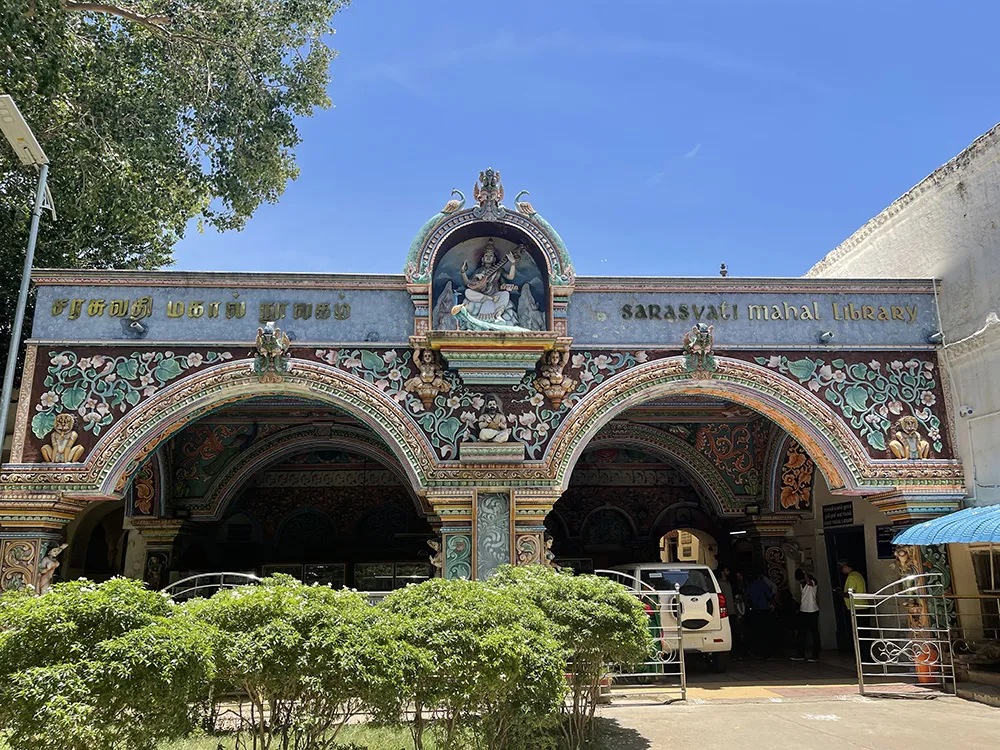
1. The Saraswathi Mahal Library
Established during the Nayak period and enriched extensively by the polymath Maratha King **Serfoji II**, the *Saraswathi Mahal Library* is one of the oldest libraries in Asia. It houses a rare collection of over 60,000 volumes, including palm-leaf manuscripts in Sanskrit, Tamil, Marathi, and Telugu, along with rare European maps, medical treatises, and hand-painted botanical atlases.
2. Maratha Durbar Hall & Royal Museum
The **Maratha Durbar Hall** features elaborate multi-colored stucco pillars, painted archways, and portraits of Maratha rulers along its elevated dais. Adjacent to the hall, the Royal Museum displays antique weapons, royal garments, coins, palanquins, and personal artifacts of the Tanjore royal family.
3. Tanjore Art Gallery (Nayak Durbar Hall)
Housed inside the spacious Nayak Durbar Hall, the **Tanjore Art Gallery** exhibits one of the finest collections of stone sculptures and Chola bronze icons in India, featuring breathtaking 10th-to-13th-century bronze statues of Nataraja, Parvati, and divine saints recovered from ancient temples.
4. Arsenal Tower & Bell Tower (Sarajah Madi)
The complex is dominated by two historic towers: the 192-foot **Arsenal Tower** (used for weapon storage and military observation) and the multi-tiered **Sarajah Madi** (Bell Tower), designed with European-style archways and decorative balconies offering sweeping views over Thanjavur.
Key Highlights & Attraction Summary
- Ancient Saraswathi Mahal Library: One of Asia's oldest libraries housing 60,000+ rare manuscripts.
- Chola Bronze Collection: World-class bronze and stone sculptures in the Art Gallery.
- Maratha Durbar Hall: Intricately painted royal audience hall featuring stucco pillars and portraits.
- Observation Towers: 192-foot Arsenal Tower and multi-tiered Sarajah Madi Bell Tower.
How to Reach Thanjavur Maratha Palace
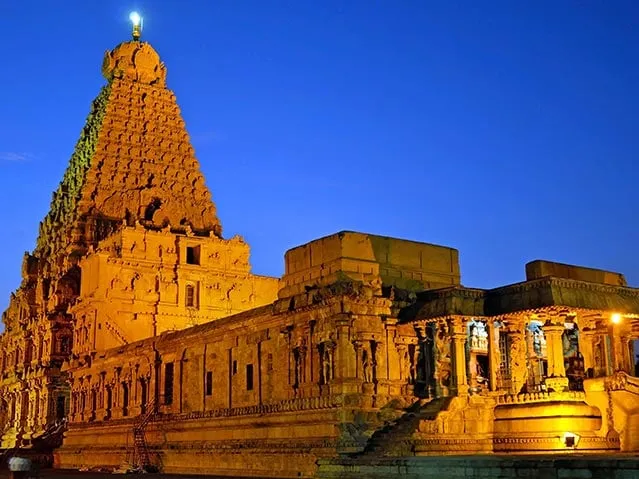
Located in central Thanjavur, just 1.5 km from the famous Brihadeeswarar Temple.
By Road from Trichy (Car, Bus, or Taxi)
Driving from Trichy city center via the Trichy–Thanjavur National Highway (NH 83) takes about 50 to 60 minutes (approx. 55 km). Frequent express state transport and private buses operate continuously between **Trichy Central Bus Stand** and Thanjavur.
By Rail & Local Transit
Express and passenger trains operate regularly between **Tiruchirappalli Junction** and **Thanjavur Junction** (approx. 45 to 60 minutes). The palace complex is located just 2 km from Thanjavur Junction Railway Station and can be reached via local auto-rickshaws or city buses.
Best Time to Visit
Operating hours, gallery entry schedules, and weather conditions govern optimal planning.
Opening Hours & Entry Fees
The palace complex and museums are open daily from **09:00 AM to 01:00 PM** and **03:00 PM to 06:00 PM** (Saraswathi Mahal Library closed on Wednesdays and public holidays). Nominal entry tickets apply for individual sections (Art Gallery, Royal Museum, and Library).
Optimal Visiting Strategy
Plan to spend **2 to 3 hours** exploring the various halls, towers, and galleries. Arriving around **09:30 AM** allows you to view the Art Gallery and Saraswathi Mahal Library comfortably before combining your day with a visit to the nearby Brihadeeswarar Temple in the late afternoon.
Things to Do at Thanjavur Palace
- View Chola Bronzes: Examine world-famous 10th-century Chola bronze masterpieces in the Tanjore Art Gallery.
- Inspect Manuscripts at Saraswathi Mahal: View historic palm-leaf scripts and rare European maps collected by King Serfoji II.
- Photograph Maratha Durbar Hall: Capture photos of the painted ceilings and stucco pillars of the royal courtroom.
- Climb the Observation Towers: View the architectural towers and surrounding cityscape from the inner courtyards.
Essential Rules and Visitor Guidelines
- Photography Restrictions: Photography is permitted in general courtyards and Durbar Halls, but restricted or subject to special fees inside specific manuscript rooms and bronze galleries.
- Preserve Heritage Artifacts: Do not touch historical paintings, glass exhibit cases, or ancient stone sculptures.
- Combine with Big Temple Visit: Located just 1.5 km from Brihadeeswarar Temple, both major sites can be easily explored on a single day trip from Trichy.
Frequently Asked Questions (FAQs)
1. Where is Thanjavur Maratha Palace located?
It is located in the center of Thanjavur town, Tamil Nadu, India, about 55 km east of Tiruchirappalli (Trichy) and 1.5 km from Brihadeeswarar Temple.
2. Who built the Thanjavur Palace?
The original complex was built by the **Nayak rulers** in the 1530s and later expanded by the **Maratha rulers** of Thanjavur in the 17th and 18th centuries.
3. What is the Saraswathi Mahal Library famous for?
It is one of Asia's oldest libraries, preserving over 60,000 rare palm-leaf manuscripts, treatises, and maps collected primarily by King Serfoji II.
4. What are the opening hours?
Open daily from **09:00 AM to 01:00 PM** and **03:30 PM to 06:00 PM**.
5. How long does a visit take?
A typical visit takes **2 to 3 hours** to explore all galleries, museums, and towers.
Conclusion
Thanjavur Maratha Palace stands out as South India's ultimate monument of royal culture, arts, and scholarship, where 16th-century Nayak-Maratha architecture, 60,000-manuscript libraries, world-famous Chola bronzes, and soaring observation towers converge near Trichy. From exploring the Saraswathi Mahal Library to photographing the Maratha Durbar Hall, the palace delivers an unmissable heritage journey. Plan your visit during morning hours, explore the royal galleries, and discover Thanjavur Maratha Palace!
Photo Gallery
What you'll experience
- 1
Historical exploration
- 2
Architectural marvel
- 3
Museum visit
- 4
Library tour
- 5
Cultural insights
Nearby Destinations
These destinations are in close proximity to Thanjavur Maratha Palace and can be visited on the same trip.
Related Destinations
Visit Information
Opening Hours
Entry Fee
Best Time to Visit
November to February
Location
Thanjavur, Tamil Nadu
Contact
For inquiries: +91-4362-230879
Share this destination:
